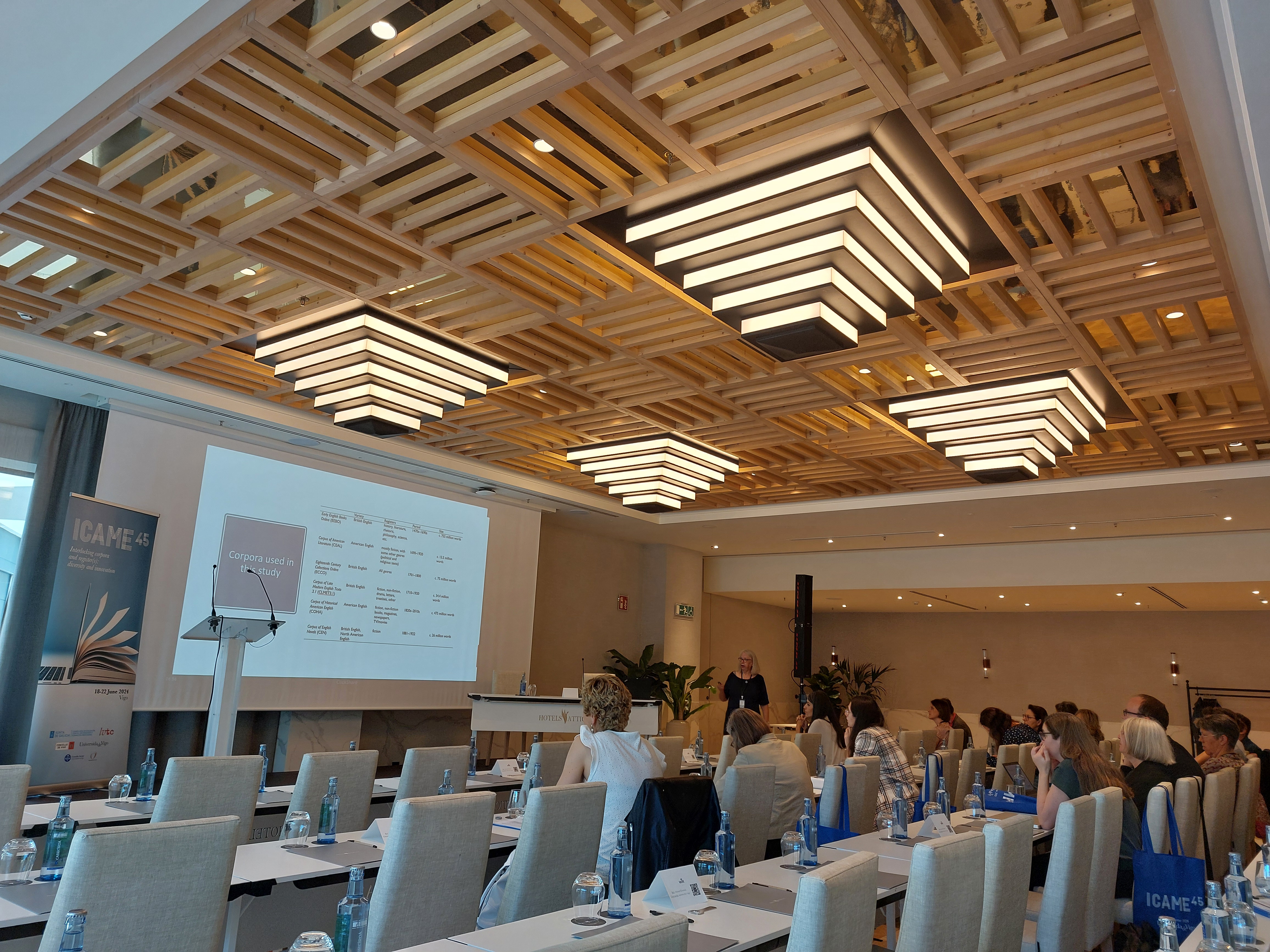
Above: Laurel Brinton presenting at the 45th ICAME Conference in Vigo, Spain.
ICAME, which stands for “International Computer Archive of Modern and Medieval Languages”, is, as described on its website, “an international group of linguists and data scientists working with English language corpora”. The first ICAME conference was held in Bergen, Norway, in 1979, and it has been held annually since then, almost always in Europe or the UK. In 1995 it was held in Toronto, though the scare about SARS reduced attendance. The computer archive mentioned in the name was responsible for the development and distribution of computer corpora (collections of linguistic data available in electronic form) in the early days, including the very important Brown Corpus of American English and Lancaster-Oslo-Bergen (LOB) Corpus of British English. It is not an overstatement to say that computer corpora have revolutionized the way in which linguistic data are collected and analyzed, and they are the standard of use today in most linguistic research. Since these early corpora, we have seen the development of specialized corpora, both historical and contemporary (such as of medieval medical recipes or Irish English) as well as huge general corpora (such as the one-billion-word Corpus of Contemporary American English). We have a small corpus of Canadian English, the Strathy Corpus, but it is now sadly somewhat dated.
At ICAME 45, I participated in a workshop on “Sociopragmatic Variation in Late Modern English”, presenting a paper entitled “I wonder if and I would be grateful if: The rise of new conventional indirect directives in Late Modern English”. This paper explored the rise of new ways of asking someone to do something (a directive). In earlier English, even through the Early Modern English period (1500–1700), commands and requests to others were typically expressed in a direct fashion (such as with an imperative sentence). It is hypothesized that this directness was possible because of the stricter social hierarchy in existence then.
Interestingly, the most common ways of requesting in Present-day English (Can/could/will/would you …?) did not arise until after 1900; rather than commanding someone to do something, these forms ask about the hearer’s willingness or ability to carry out an action. This is what is termed an “indirect speech act”. My paper explores the myriad other indirect ways that we have today of issuing requests, focusing on the “appreciative” I would be grateful if and the “deliberative” I wonder if. The majority of these constructions first came into use in the Late Modern English (1700–1900) and Present-Day English (1900–) periods. The use of indirect ways of requesting is seen as the result of “negative politeness” in the contemporary society, in which the speaker tries not to impose or put pressure upon the hearer. The research underlying this paper was based on the use of a number of different corpora and text collections of historical English.
Prior to attending the conference, I presented two papers at Uppsala University and was interviewed by Merja Kytö about my career for a piece that appeared in the Journal of English Linguistics; it can be accessed here. Merja was a pioneer in the development of electronic corpora, being a driving force behind the Helsinki Corpus, the first corpus spanning the entire history of the English language.